
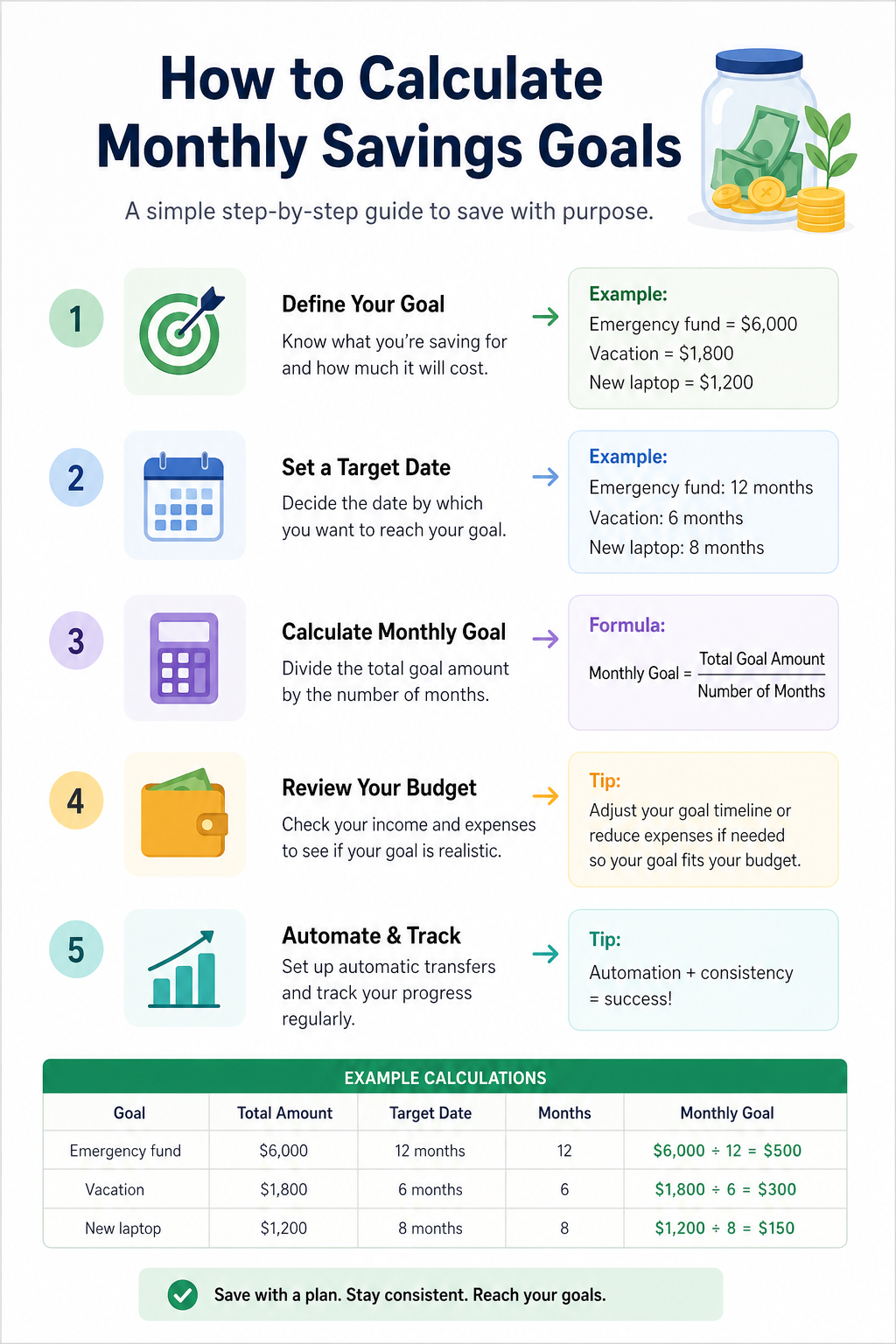
How to Calculate Monthly Savings Goals Without Guessing Your Budget: A Precision Approach to Financial Goal Setting
Most people approach saving money with vague intentions rather than mathematical precision. They commit to “saving more” or “cutting back on spending” without a concrete, quantified plan — and then wonder why their savings account balance looks unchanged month after month despite genuine effort. The fundamental problem is that successful savings requires the same systematic, goal-oriented approach that successful businesses apply to financial planning. You need a specific target, a realistic timeline, a mathematically derived monthly contribution amount, and a structured tracking system to measure progress. The good news: modern financial calculators eliminate the guesswork completely. Use our Smart Savings Calculator for Future Financial Goals to calculate your exact monthly savings requirement for any goal in seconds.
The Three-Step Framework for Precision Savings Goal Setting
Every savings goal — whether building an emergency fund, saving for a house down payment, funding a vacation, or accumulating retirement assets — can be broken down into three essential quantitative inputs that completely determine the required monthly savings amount:
Input 1: The Target Amount (Goal Value)
Define your savings goal with complete precision. Vague goals (“I want to save for a house”) produce vague results. Specific goals (“I need $60,000 for a 20% down payment on a $300,000 house, plus $5,000 closing cost buffer, for a total target of $65,000”) produce actionable monthly savings requirements. Research the exact cost of your target goal carefully. For a house down payment, include: down payment amount, estimated closing costs (2% to 5% of purchase price), moving expenses, initial furniture and appliance costs, and emergency repair reserve. For a vehicle, include: down payment percentage, sales tax, registration, and initial insurance premium.
Input 2: The Time Horizon
Decide exactly when you need the money. Time horizon is the most powerful variable in savings planning because it directly determines the monthly contribution required — and because of compound interest, even small extensions in time horizon dramatically reduce monthly savings requirements. Compare: saving $65,000 in 3 years requires $1,736 per month at 4% interest; the same goal over 5 years requires only $987 per month. Understanding your income and salary timeline helps calibrate realistic time horizons using our Professional Salary Calculator.
Input 3: The Expected Return Rate
Your savings vehicle — where you keep the money while accumulating it — determines the interest rate applied to your growing balance. Current high-yield savings accounts offer 4% to 5% APY. Certificates of deposit provide similar rates with fixed terms. Money market accounts offer competitive rates with higher liquidity. For goals within 1 to 2 years, use only capital-guaranteed vehicles (savings accounts, CDs) to eliminate market risk. For goals 5 or more years away, partial allocation to diversified investments can increase effective return rates while accepting short-term volatility risk.
Calculating Your Required Monthly Savings Contribution
The precise formula for calculating the required monthly savings deposit to reach a specific goal is the Future Value of Annuity equation solved for payment amount:
Monthly Savings Required Formula:
PMT = FV × r / [(1 + r)n − 1]Where: FV = Target goal amount | r = Monthly interest rate (annual rate ÷ 12) | n = Number of months to goal
Worked Example: You want to accumulate $25,000 for a vehicle purchase in 2 years (24 months), earning 4.5% annual interest (0.375% monthly):
PMT = 25,000 × 0.00375 / [(1.00375)24 − 1] = $93.75 / 0.09381 = $999.36 per month
Without earning any interest (0% return), you would need $25,000 ÷ 24 = $1,041.67 per month. The 4.5% interest rate saves you $42.31 per month — or $1,015 over the 2-year period. Our Smart Savings Calculator performs this calculation instantly for any combination of inputs.
Savings Goals by Priority: The Recommended Financial Order
When you have multiple competing savings goals — emergency fund, retirement, house down payment, vacation — the financially optimal sequencing maximizes long-term wealth while maintaining adequate financial protection:
Priority 1: Emergency Fund (Non-Negotiable Foundation)
Before any other savings goal, accumulate 3 to 6 months of all essential living expenses in an immediately accessible high-yield savings account. This liquid reserve protects all other financial plans from derailment by unexpected expenses. Without an emergency fund, any major unexpected expense forces expensive credit card debt or personal loan borrowing, derailing progress on all other financial goals simultaneously. Calculate your monthly essential expenses using our Monthly Budget Calculator.
Priority 2: Employer Retirement Match
If your employer offers any matching contribution to a 401(k) or equivalent retirement plan, contribute at minimum the percentage required to capture the full match before addressing any other savings goal. Employer matching is an instant 50% to 100% return on the matched contribution — no investment vehicle competes with this guaranteed return. Skipping this match while paying extra toward other goals is a significant financial error.
Priority 3: High-Interest Debt Elimination
After securing the emergency fund and employer retirement match, aggressively eliminate all debt carrying interest rates above 7% to 8% annually. Credit card balances at 20%+ rates compound at devastating speed, and eliminating them provides a guaranteed risk-free return equal to the interest rate avoided. Track your debt payoff using our Professional Loan & EMI Calculator.
Priority 4: Additional Retirement Savings
Maximize tax-advantaged retirement contributions (traditional/Roth IRA, remaining 401(k) capacity) to benefit from compound growth over decades plus valuable tax advantages.
Priority 5: Other Specific Financial Goals
House down payment, vehicle fund, education savings, travel fund, and other personal financial goals receive systematic monthly contributions after the foundational priorities above are addressed.
High-Yield Savings Vehicles Comparison
| Savings Vehicle | Typical APY (2024) | Liquidity | Best For |
|---|---|---|---|
| High-Yield Savings Account | 4.5% – 5.3% | Immediate | Emergency fund, short-term goals |
| Money Market Account | 4.3% – 5.1% | Near-immediate | Emergency fund with check-writing |
| 6-Month CD | 4.8% – 5.5% | Locked 6 months | Goals in 6+ months |
| 12-Month CD | 4.5% – 5.2% | Locked 12 months | Goals in 12+ months |
| Treasury Bills (T-Bills) | 4.9% – 5.4% | At maturity | Risk-free, government-backed returns |
| I-Bonds (Inflation-Linked) | Variable (inflation-tied) | After 12 months | Inflation protection for 2-5yr goals |
The Savings Automation Principle: Set It and Forget It
The single most evidence-backed behavioral strategy for consistent savings achievement is full automation. Configure automatic transfers from your checking account to your designated savings accounts on the exact date your paycheck arrives — before you have any opportunity to spend the money. This “pay yourself first” approach removes the psychological burden of conscious monthly savings decisions and eliminates the temptation to redirect savings toward discretionary spending.
Research on retirement savings participation rates confirms that automatic enrollment dramatically outperforms opt-in programs. Employees automatically enrolled in 401(k) plans show 90%+ participation rates; those requiring voluntary enrollment show only 40% to 60% participation despite identical financial benefits. The same principle applies to all personal savings goals: automation converts good intentions into reliable financial outcomes. Understand the tax efficiency of your savings contributions using our Income Tax & Salary Calculator.
Adjusting Savings Goals When Budget Is Tight
When your calculated required monthly savings amount exceeds what your current budget supports, you have three levers to adjust:
- Extend the Time Horizon: Adding 12 to 24 months to your goal timeline significantly reduces monthly requirements while compound interest continues growing your balance.
- Reduce the Target Amount: For discretionary goals (vacations, upgrades), scaling back the target amount directly reduces monthly contributions. For non-negotiable goals (down payment for a specific property), explore whether a lower-priced target achieves similar life satisfaction.
- Increase Monthly Income: Side income from freelancing, part-time work, selling unused possessions, or requesting a salary increase can bridge the gap between current savings capacity and required monthly contributions. Model salary increase impacts using our Professional Salary Calculator.
The least recommended approach is reducing savings rate for non-discretionary priority goals (emergency fund, retirement) — compromising foundational savings exposes your entire financial plan to catastrophic disruption risk.
Tracking Progress and Celebrating Milestones
Regular savings tracking maintains motivation and provides early warning when contributions fall behind schedule. Review your savings account balances monthly against the projected accumulation schedule from our Smart Savings Calculator. If you fall behind in any month, calculate the catch-up contribution needed in subsequent months to return to schedule rather than accepting permanent deficit. Celebrating milestone achievements — reaching 25%, 50%, and 75% of your target — maintains psychological momentum for the full journey to goal completion.
Frequently Asked Questions About Savings Goals
Q1: How much should I have saved by different life stages?
Common financial planning benchmarks by age: By age 30, 1× annual salary saved for retirement. By age 40, 3× annual salary. By age 50, 6× annual salary. By age 60, 8× annual salary. By retirement, 10× to 12× annual salary. These are general guidelines that vary significantly based on planned retirement age, lifestyle expectations, and Social Security benefit amounts.
Q2: Should I save in a joint or individual account?
For shared financial goals (house down payment, vacation, emergency fund), joint savings accounts provide transparency and mutual accountability, reducing the risk of either partner undercontributing. For individual goals (personal retirement, professional development), individual accounts ensure personal financial autonomy and independent goal tracking.
Q3: Is it better to save for a large goal or invest in the market?
For goals within 1 to 3 years: use capital-guaranteed savings accounts to eliminate sequence-of-returns risk — a market downturn just before your planned withdrawal could devastate your goal timeline. For goals 5+ years away: market investments historically outperform savings account rates, making them appropriate for longer-horizon goals where short-term volatility can be absorbed. Evaluate long-term investment returns using our ROI Calculator.
Q4: What happens to my savings goal calculations when interest rates change?
As interest rates change (driven by central bank monetary policy), the effective APY on savings accounts and CDs adjusts accordingly. Recalculate your required monthly savings contribution whenever your savings account rate changes by 0.5% or more. Higher rates reduce the required monthly contribution for the same goal; lower rates require higher monthly contributions. Our Smart Savings Calculator lets you instantly model any rate scenario.
Q5: How do I balance multiple savings goals simultaneously?
Create separate dedicated savings accounts for each major goal with automatic monthly transfers assigned to each account. This separation provides clear visual progress tracking for each individual goal and prevents accidentally spending goal-earmarked funds on other purposes. Most online banks allow unlimited free savings accounts, making this organizational system cost-free to implement.